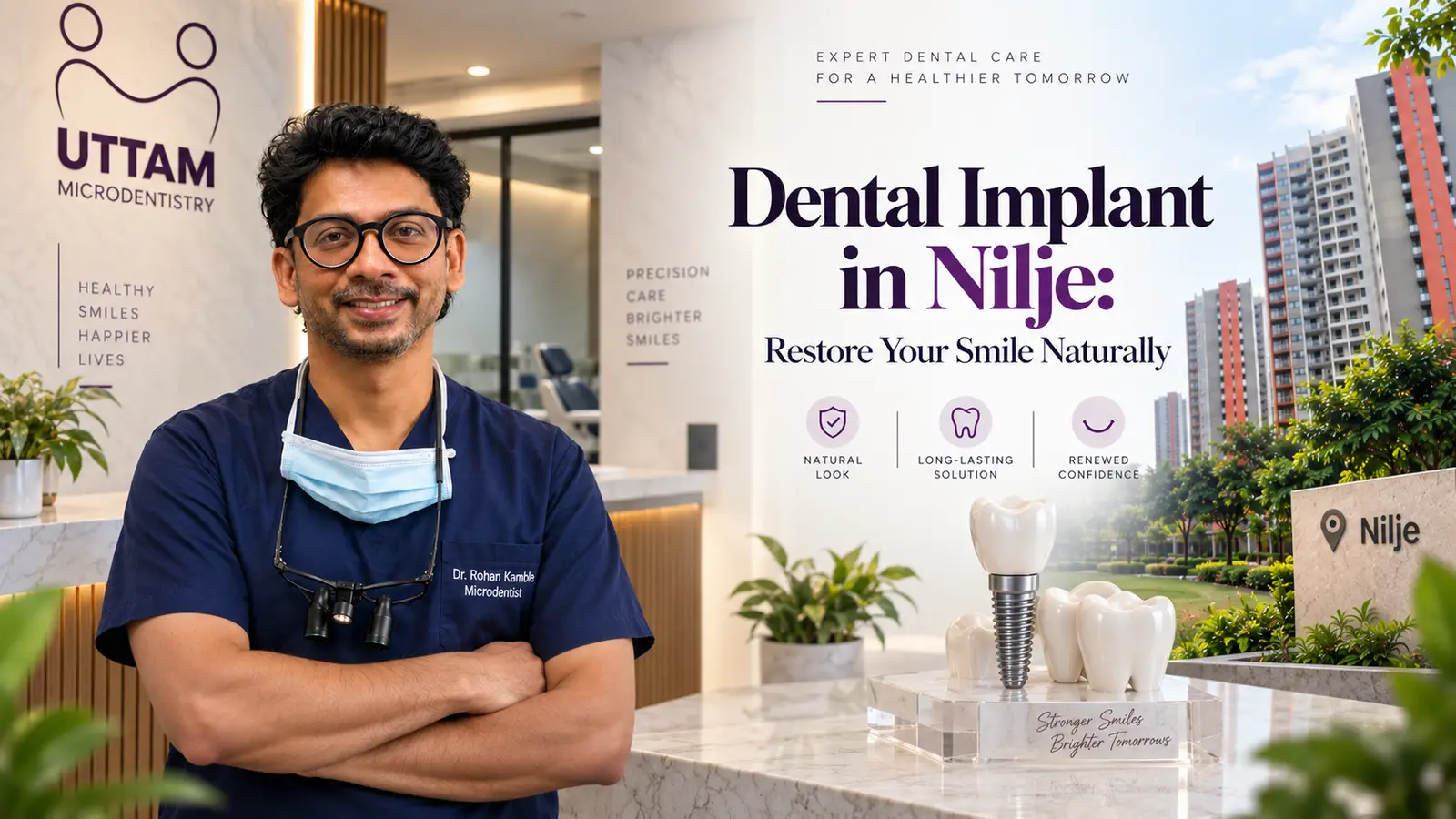
Dental Implant in Nilje: Restore Your Smile Naturally
Dr. Rohan Kamble
Founder & Implantologist
“Living with a missing tooth can slowly become part of your routine. You may chew more on one side, avoid certain foods, or feel less confident when smiling.”
Introduction
Living with a missing tooth can slowly become part of your routine. You may chew more on one side, avoid certain foods, or feel less confident when smiling. Even when a missing tooth causes no pain, the gap can affect how nearby teeth meet and how pressure is shared during chewing. The jawbone in the empty area can also gradually change after tooth loss. For these reasons, replacing a missing tooth is worth discussing even if you have already adapted to the gap.
If you are searching for a Dental Implant in Nilje, you may be looking for a fixed replacement that feels secure and fits naturally with your existing teeth. An implant-supported crown is designed to replace both the missing tooth and its root support. However, implant treatment is not identical for every patient. The condition of the gums, available bone, bite, location of the missing tooth, and overall oral health all influence the plan.
At Uttam Microdentistry, Dr. Rohan Kamble, a trusted dental expert in general dentistry and implant care, can assess your missing tooth area and explain the most suitable options before treatment begins. A typical implant journey may include examination, dental imaging, preparation if required, implant placement, healing, and fitting of the final crown. Understanding these stages in advance helps patients make an informed decision rather than choosing a treatment only because it is popular.
What Is a Dental Implant?
A dental implant is a small post placed in the jawbone to replace the root of a missing tooth. After the implant has healed, an abutment connects it to a dental crown, which restores the visible tooth. Together, these parts provide a fixed tooth-replacement option that can work independently of the neighbouring teeth.
Why Should a Missing Tooth Be Replaced?
A gap can affect more than appearance. Nearby teeth may gradually move toward the empty space, while the bone that supported the lost root can remodel over time. A missing back tooth may also reduce chewing efficiency. Tooth replacement can help restore function and maintain a more balanced dental arch.
Benefits of Dental Implants
- ✓Fixed support for a replacement tooth.
- ✓Improved chewing function for suitable patients.
- ✓A single implant can replace one tooth without using neighbouring teeth as bridge supports.
- ✓A custom crown can be designed to blend with surrounding teeth.
- ✓A long-term option when supported by good oral hygiene and regular dental care.
Who Is a Good Candidate for an Implant?
Suitability depends on the health of the gums, jawbone, bite, and remaining teeth. Patients also need to be able to maintain good oral hygiene and follow aftercare instructions. Age alone does not decide whether an implant is appropriate. If gum disease, infection, inadequate bone, or another dental problem is present, it may need to be addressed first. Some patients also ask whether dental aligners could be used alongside implant planning to improve the position of remaining teeth before or after treatment.
How Does Dental Implant Treatment Work?
Treatment begins with a consultation and examination. Imaging may be used to assess the bone and nearby structures. If the site is suitable, the implant is placed under local anaesthesia and allowed to heal. Once the implant is stable, the abutment and final crown are fitted. The number of visits and total treatment time vary according to the individual case.
How Long Does a Dental Implant Take?
Implant treatment usually takes longer than a routine filling or crown because the implant needs a healing period before the final restoration is fitted. Some cases may take a few months, while cases needing additional preparation can take longer. The dentist can provide a more realistic timeline after examining the tooth area.
Dental Implant vs Bridge or Denture
A bridge fills a gap by using neighbouring teeth for support, while a removable denture can replace one or several missing teeth and is taken out for cleaning. An implant-supported crown is fixed in the mouth and uses the jaw as its foundation. For patients missing all teeth, all-on-4 dental implants may also be a suitable dental prosthesis to explore. The best choice depends on the number of missing teeth, gum and bone health, comfort, maintenance, dental replacement cost, and personal preference. Your dentist can also help you understand how dental calculus build-up may affect gum health around any restoration over time.
What About Bone Loss After Tooth Loss?
The jawbone can gradually change after a tooth is lost because the natural root is no longer present. The amount of change varies between people. If there has been significant bone loss, additional treatment may sometimes be discussed before an implant can be placed. Dental imaging helps determine the condition of the site.
How Should You Care for an Implant?
An implant still needs daily care. Brush twice a day and clean between the teeth and around the implant to prevent dental plaque build-up. If plaque is not removed regularly it hardens into dental calculus that requires professional cleaning. Avoid using the crown to bite very hard objects. Persistent bleeding, swelling, pain, a change in the bite, or looseness should be checked by a dentist.
Why Choose Uttam Microdentistry for Implant Care?
Patients searching for dental implants near me often want clear information before committing to treatment. As a trusted family dental clinic, Uttam Microdentistry and Dr. Rohan Kamble can assess the missing tooth area, explain suitable options, discuss the expected stages, and help patients understand the care required after treatment. The aim is to create a treatment plan based on the patient's actual dental condition rather than a one-size-fits-all approach.
Frequently Asked Questions
Is a dental implant painful?
The procedure is performed with local anaesthesia, so the treatment area is numbed. Some soreness or swelling can occur during healing and can usually be managed with the dentist's instructions.
Can one implant replace one missing tooth?
Yes. A single implant can support one crown and can replace an individual missing tooth without using neighbouring teeth as bridge supports.
How long does an implant last?
An implant can be a long-term tooth-replacement option when it is properly planned, maintained, and regularly checked.
Can I get an implant after a tooth extraction?
Yes, depending on the condition of the extraction site. The timing may be immediate or after healing, depending on the individual case.
How do I know if I am suitable?
A dental examination and imaging can assess the gums, bone, bite, and missing-tooth area. If you have been searching for a dentist accepting new patients near me, Uttam Microdentistry welcomes new patients for an initial assessment. The dentist can then explain whether an implant is appropriate.
Conclusion
If you are considering a Dental Implant in Nilje, start with an assessment at Uttam Microdentistry — a family dental clinic trusted by patients across the area. Rather than choosing a treatment based only on appearance or price, book a dentist appointment with Uttam Microdentistry and Dr. Rohan Kamble to understand the condition of the missing-tooth area, compare replacement options, and plan the next steps. A clear treatment plan can make the process easier to understand and prepare for.
Book a Consultation
Get expert dental advice from Dr. Rohan Kamble at Uttam Microdentistry, Dombivli.
Book Appointment